
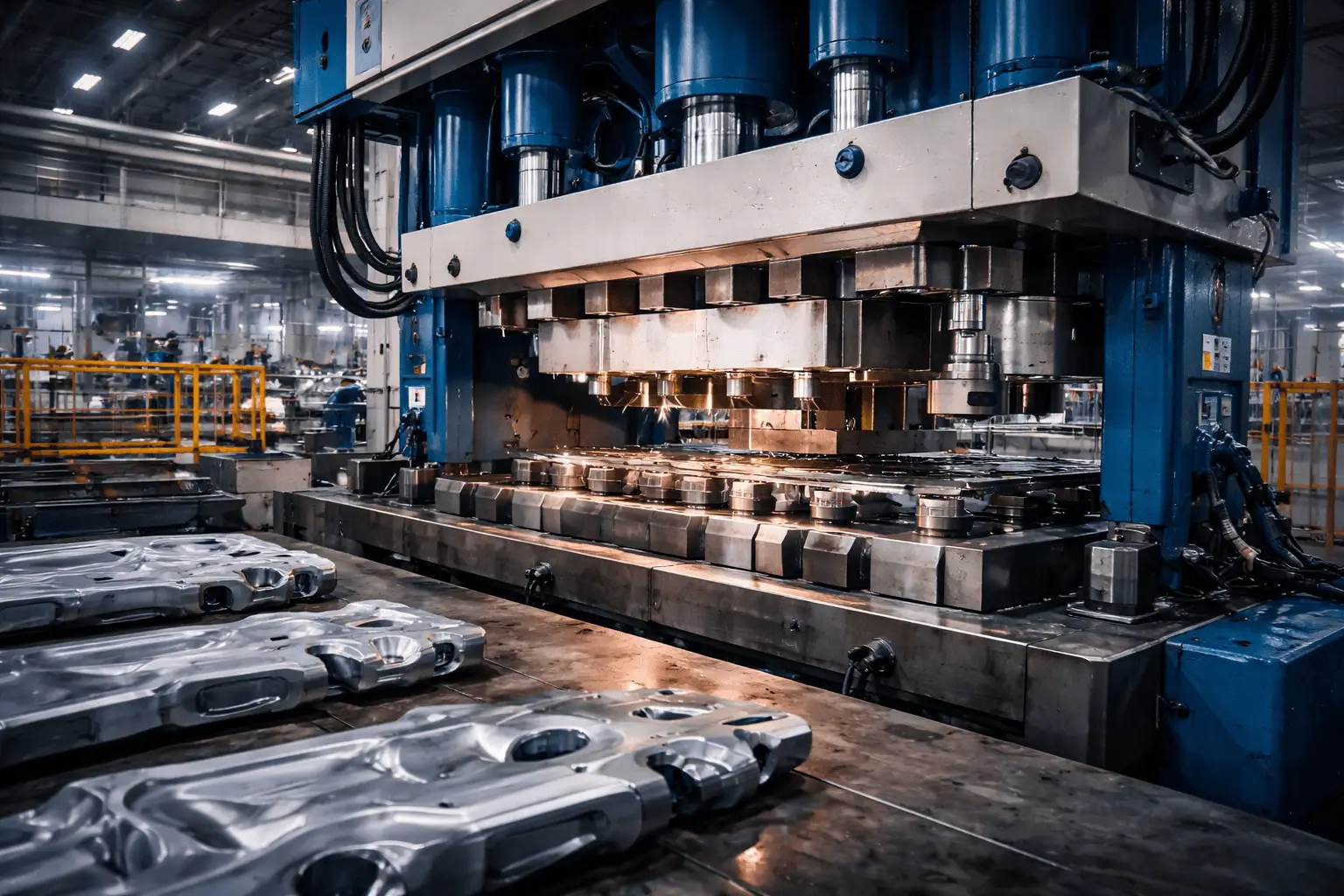
Hydraulic presses play a crucial role in modern automotive component manufacturing, particularly as vehicle designs become more complex and material requirements more demanding. With increasing use of deep-drawn geometries, high-strength steels, and stainless steel components, manufacturers require forming solutions that offer precise control and process stability. Hydraulic presses meet these needs by providing consistent force application throughout the forming cycle.
Unlike mechanical presses, hydraulic presses allow independent control of pressure, stroke length, forming speed, and dwell time. This level of control is especially important for producing deep-drawn and complex parts, where uniform material flow is critical to avoid defects such as tearing, wrinkling, or thinning. As a result, hydraulic presses are widely used for components that demand tight dimensional accuracy and high structural integrity.
At Exenus, high-tonnage hydraulic presses are employed to manufacture a range of automotive components used in structural, load-bearing, and functional applications. These presses enable stable forming conditions across varying material thicknesses and grades, ensuring repeatable quality even in high-volume production environments. Optimized press parameters and well-engineered tooling contribute to improved surface finish, reduced scrap rates, and longer tool life.
Another key advantage of hydraulic pressing lies in its adaptability. Hydraulic presses can accommodate different part designs and materials with minimal changeover, making them well-suited for today’s automotive manufacturing landscape, where platform flexibility and shorter product lifecycles are becoming increasingly common. This flexibility supports faster development cycles and allows manufacturers to respond quickly to changing OEM requirements.
As the automotive industry continues to evolve—with a growing focus on lightweighting, safety, and electrification—the demand for precision-formed components will only increase. Hydraulic presses will remain a preferred solution for applications requiring controlled forming, consistent quality, and enhanced durability. Their ability to handle advanced materials and complex geometries ensures they will continue to play a vital role in shaping the future of automotive component manufacturing.
Leave A Comment